
Social and economic factors—including access to quality housing and jobs, and opportunities to start and grow a business—shape the health and well-being of communities. Healthcare Anchor Network (HAN) and the Local Initiatives Support Corporation (LISC) are dedicated to helping institutions leverage their financial resources to invest in these social drivers of health to create resilient communities. This is the first of a two-part series highlighting how HAN members are partnering with LISC to invest in affordable housing and economic development.
HAN works with nonprofit health systems to accelerate place-based impact investing in communities where they provide clinical care, prioritizing investments that increase economic mobility and build community wealth. Similarly, LISC, a leading community development financial institution (CDFI) with local offices throughout the country, provides grant dollars, investments, and technical assistance in under-resourced areas to foster economic growth.
Substantial gaps in economic opportunity have contributed to negative health outcomes across the country. Low-income communities, in particular, often face higher levels of preventable diseases, inadequate housing, and limited opportunities.
CDFIs play a critical role in addressing social drivers of health by providing capital and services for affordable housing, real estate development, and small businesses.
Recognizing the connection between economic stability and health outcomes, members of HAN have adopted an anchor mission, a commitment to leverage their assets, such as their hiring, purchasing, and investing practices, for positive community impact. By aligning these assets with community needs, health systems can create pathways for economic mobility and prosperity for residents across their footprints.
CDFIs, like LISC, play a critical role in addressing social drivers of health by providing capital and services for affordable housing, real estate development, and small businesses in under-resourced areas. Health systems and CDFIs can amplify their impact through collaboration, as CDFIs offer financial expertise and understanding of the local investment landscape, while health systems provide low-cost, long-term capital for high-impact projects and organizations. By working together and combining resources, health systems and CDFIs can strengthen local economies and build healthier communities.
Over the past seven years, LISC has partnered with 20 HAN members on initiatives that promote economic development and community resilience. HAN members have deployed $107 million through LISC, including $84 million in loans and $23 million in grants, to help finance affordable housing, small business lending, real estate development, local economic development strategies, and community wealth building. These efforts have impacted communities in 23 of LISC’s local markets. In the first of a two-part series highlighting our partnership, we share our affordable housing highlights.
Affordable Housing Development
Safe, affordable housing isn’t just about shelter; it’s the foundation for healthy lives. When families face skyrocketing prices, homelessness, or substandard conditions, their physical and emotional well-being suffers. Many neighborhoods grapple with housing shortages, rising cost of living, aging properties, and affordable housing development barriers. But when funders, developers, and grassroots organizations come together with creative approaches to building and preserving affordability, they can help offset challenges and build healthier, more resilient communities.
In recent years, LISC has leveraged grant and loan capital from HAN members to finance innovative models of affordable housing, bringing low-cost, long-term capital needed to attract institutional investors, close financing gaps, and increase the supply of quality affordable housing. The following examples illustrate the positive impacts of this critical capital.
HAN members have deployed $107 million through LISC, including $84 million in loans and $23 million in grants, to help finance affordable housing, small business lending, real estate development, local economic development strategies, and community wealth building.
Modular Housing: Los Angeles (CommonSpirit)
CommonSpirit Health’s Community Investment Program partnered with LISC to address the housing crisis in Los Angeles County. In partnership with other philanthropic institutions in the region, they established a $6.2 million Modular Housing Fund, including a $1.2 million loan from CommonSpirit’s Community Investment Program, to provide critical early financing for modular affordable housing projects. Modular housing is a method of construction in which homes are built in sections in a factory and then transported and assembled on-site, offering a faster, cost-effective way to increase the supply of housing and combat homelessness.
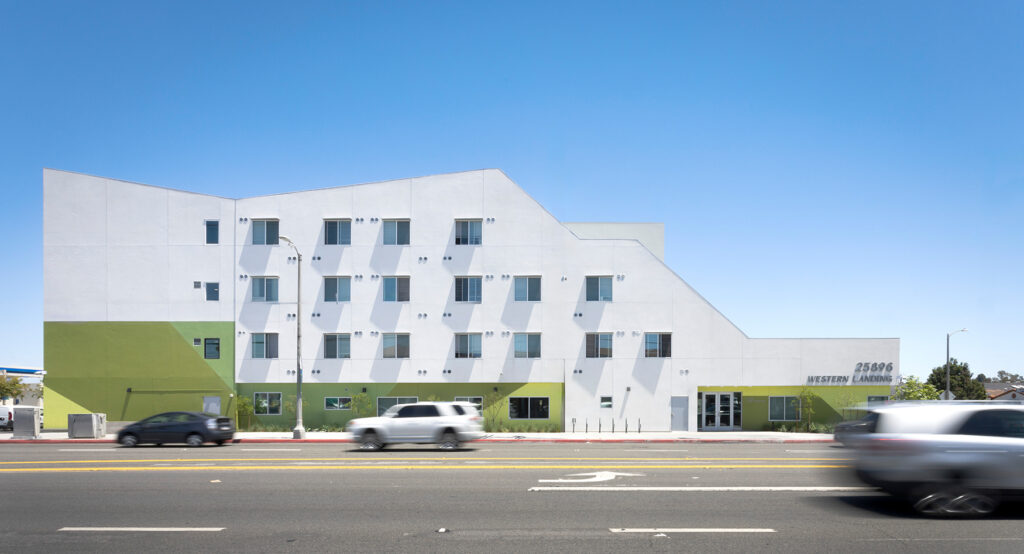
Through the Modular Housing Fund, LISC provided $2.16 million in predevelopment financing to Abode Communities for the development of Western Landing, an 80-unit residence for people experiencing homelessness, with incomes at or below 30% of the area median income (AMI). The project includes a residence for an on-site manager, landscaped outdoor space, property management and resident services offices, and community space. The property is near public transit and other amenities, including a pharmacy, park, and medical clinic and hospital.
Opened in November 2024, Western Landing achieved the original aims of the Modular Housing Fund: realizing both cost and time savings through streamlined site selection, standardized and scalable design, and efficient modular construction. In addition, Western Landing provides extensive support services for residents that contribute to their health, well-being, and housing stability.
The Modular Housing Fund leverages another critical source of financing: the city of Los Angeles’ $40 million HHH Innovation Challenge Award, a portion of which supported Western Landing. The city awarded this funding to a collaborative of nonprofit housing developers, including Abode Communities, to develop a total of 398 units of permanent supportive housing in five modular housing projects.
Supportive Housing: Connecticut (Trinity Health Of New England)
LISC, with loan capital from Trinity Health Of New England and other lending partners, provided a $530,000 loan to Neighborhood Housing Services of New Britain, Inc. (NHSNB) to acquire the former Kern Tool and Die Facility. The building is located in the heart of New Britain’s city center and exemplifies New Britain’s strong manufacturing past. New Britain is nicknamed the “Hardware City” for its industrial heritage dating back to the 19th century as the home to Stanley Works, The American Hardware Corporation, and other manufacturing companies.
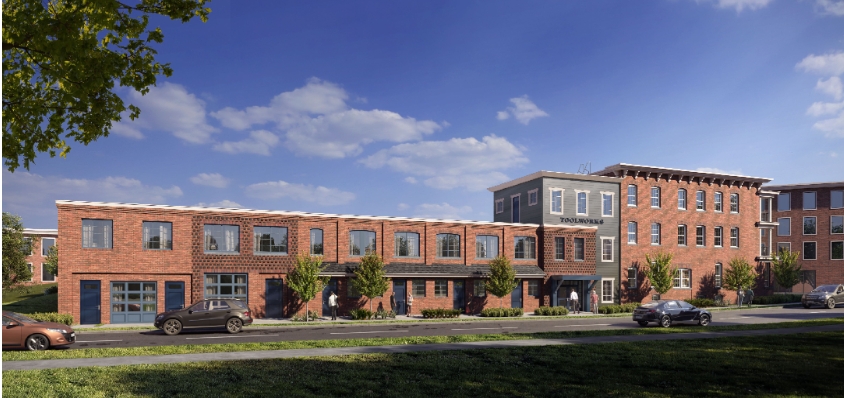
This financing allowed NHSNB to proactively secure this important community asset, which its team will redevelop into 14 affordable housing units, including three units of permanent supportive housing for adults experiencing homelessness. “The financing from our partners at Trinity Health Of New England allowed LISC to provide long-term capital to this important project. The loan not only allowed NHSNB to secure the property but has also allowed it the time needed to garner community input, fully develop the project scope, and secure permanent financing for the project,” said Jim Horan, senior executive director of LISC Connecticut.
Housing Example: Workforce Housing Milwaukee (Aurora Health Care)
With loan capital from Aurora Health Care (now part of Advocate Health), LISC provided a $517,000 predevelopment loan to Milwaukee-based real estate development company Maures Development Group, LLC, to support a scattered site housing development in the Harambee neighborhood of Milwaukee. The project, Bronzeville Estates, represents $8 million of total investment and includes a mix of 30 new construction and renovated housing units with two-, three, – and four-bedroom options. More than two dozen of those units are offered at affordable price points. Bronzeville Estates also includes a community service facility run by a local nonprofit to conduct workshops for entrepreneurs who want to start and grow their own businesses.
Affordable Housing Preservation: Boston (Mass General Brigham)
Through the Massachusetts Determination of Need process, which regulates community investment by nonprofit hospitals, Massachusetts General Hospital (MGH), a founding member of the Mass General Brigham heath care system, awarded LISC $1.1 million in Community Health Impact Funding to support affordable housing initiatives. With this support, LISC launched the Community-Based Predevelopment and Acquisition Fund to give affordable housing developers immediate access to capital in a highly competitive market. This funding will reverberate for years to come: loans repaid to LISC will be recycled into additional community-driven affordable housing in the future.
LISC utilized a portion of this funding to provide a $1.75 million acquisition and construction loan to Asian Community Development Corporation for the purchase of a six-story building in Boston’s Chinatown neighborhood. The project preserves 14 affordable apartments for people earning between 30% and 80% of area median income (AMI), protecting current residents, and retains the current commercial tenant, the New Golden Gate restaurant. This project helped stabilize the building with long-term affordability requirements, while improving the quality of the building by completing necessary upgrades.

Community Land Trust: Bay Area (Kaiser Permanente)
LISC and Kaiser Permanente collaborated to invest in under-resourced communities through a combination of loans and grants. Their contribution, along with several others, allowed LISC to provide a $3 million acquisition loan to the San Francisco Community Land Trust (SFCLT) to acquire 285 Turk Street in the Tenderloin neighborhood of San Francisco. The building includes 40 affordable residential units and two community-serving commercial spaces.
Established in 2004, SFCLT is a membership-based organization whose mission is to create permanently affordable, resident-controlled housing for low-to-moderate-income people through community ownership of the land.

The building is currently home to 29 households. Because the building is not under rent control, tenants would be vulnerable to displacement if the building were to be purchased by a speculator. The longer-term goal is to form with the tenants a Limited Equity Housing Co-operative to promote housing stability, limited equity home ownership, and asset building by tenants.