
Healthcare Anchor Network (HAN) and the Local Initiatives Support Corporation (LISC) are dedicated to helping institutions leverage their financial resources to invest in key social drivers of health to create resilient local communities. Over the past seven years, LISC has partnered with 20 HAN members on initiatives that promote economic development and community resilience. HAN members have deployed $107 million through LISC, including $84 million in loans and $23 million in grants, to help finance affordable housing, small business lending, real estate development, local economic development strategies, and community wealth building. These efforts have impacted communities in 23 of LISC’s local markets.
This story is the second in a two-part series highlighting how HAN members are partnering with LISC. Read more about affordable housing investments here and economic development below.
Over the past seven years, LISC has partnered with 20 HAN members on initiatives that promote economic development and community resilience.
Economic Development
Thriving commercial corridors and small businesses promote economic growth and financial security by connecting residents to services and job opportunities. Financial security increases access to clinical care, insurance, and health services while having positive impacts on mental health that can lead to improved living conditions and healthier lifestyles.
Disinvestment, particularly in low-income communities, has hindered the development of commercial corridors and has impacted residents’ ability to build wealth. With loan capital from HAN members, LISC is able to invest in commercial spaces and mixed-use development, supporting thriving communities with amenities, job opportunities, and a strong social fabric.
What’s more, grant funding from HAN members supports the adoption of a model for community-centered economic development, which advances a wide spectrum of community investment priorities— from housing and workforce development to food access and placemaking.
The following examples illustrate the positive impacts of this critical capital.
Mixed-Use: Atlanta (Kaiser Permanente, Front Porch)
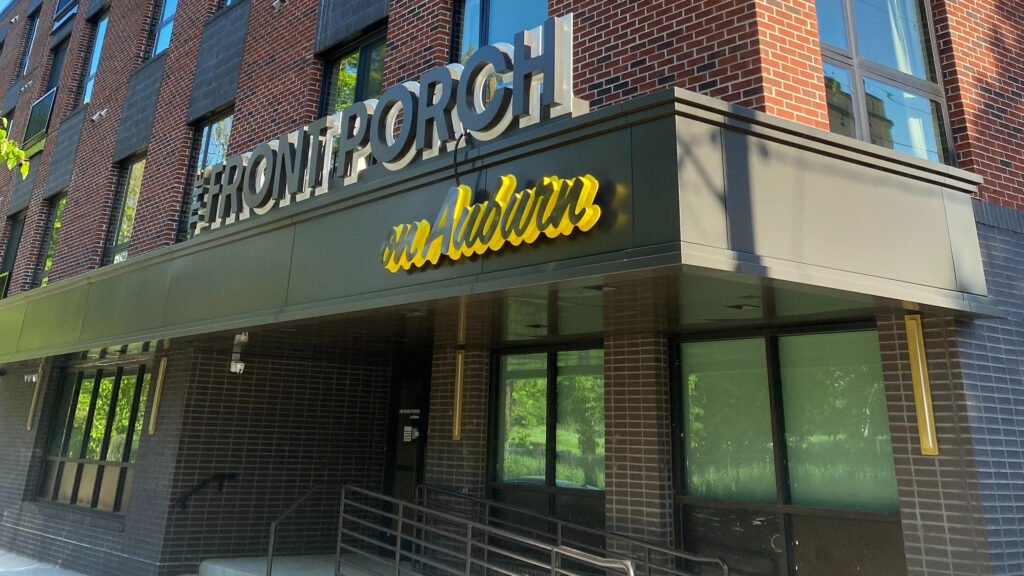
Kaiser Permanente partnered with LISC to provide a $4.5 million loan to the Historic District Development Corporation, supporting the revitalization of Atlanta’s Sweet Auburn and Old Fourth Ward neighborhoods while preventing displacement. The loan supported the construction of Front Porch, a mixed-use development designed to catalyze investment along Auburn Avenue and promote housing and economic opportunities. The project features 36 residential co-living and traditional units, 70% of which are affordable to people earning up to 80% of the area median income, along with six commercial spaces and community-focused amenities that include a rooftop garden, artist studios, event space, and affordable commercial space for local entrepreneurs.
Economic Development: Industrial Chicago (Advocate Health Care, Amped Kitchens)
LISC provided a $6 million loan to Civic Enterprise Development (CED) to acquire and rehabilitate a 117,000-square-foot vacant building into Amped Kitchens, a multi-tenant food manufacturing facility creating a hub for small food manufacturers in the Belmont Cragin neighborhood of Chicago into a hub for small food manufacturers. New Markets Tax Credits financed the rehabilitation of more than 60 pre-inspected, ready-to-occupy wholesale kitchen spaces for start-ups, and under-resourced businesses.

LISC utilized loan capital from Advocate Health Care to significantly reduce the interest rate to the end borrower, a boon to the project as it completed construction during the COVID-19 pandemic and required breathing room for lease-up. At full capacity, the facility is expected to employ 260 full and part-time workers.
Amped Kitchens Chicago rents permit-ready, private commercial kitchen spaces in various sizes, as well as office space, meeting rooms, attended shipping docks, packing rooms, and an on-site U.S. Department of Agriculture office. In addition, Amped Kitchens’ tenants have access to expedited government approvals and easier certification for specialty food markets.
Commercial: Twin Cities (Allina Health, Coliseum project)
In 2020, The Coliseum, a landmark commercial building in a working-class commercial corridor along Lake Avenue in South Minneapolis, was badly damaged by fire. Rather than see it demolished or snapped up by speculators, a local funding collaboration that includes Allina Health, LISC, and community organizations harnessed nearly $30 million in public and private money to restore and upgrade the 85,000-square-foot building, and own and operate it going forward.
This project was supported by the Community Asset Transition Fund (CAT), a pool of impact capital launched by LISC Twin Cities to support the economic recovery of local cultural districts. Allina Health is an investor in the $36 million CAT Fund, which combines patient, low-cost financing with predevelopment and capacity building grants to support local developers working to transform their communities.
With loan capital from Allina Health, the coalition that included LISC, community organizations, and business owners worked over four years to transform The Coliseum into office and retail space, which reopened during a community Juneteenth celebration in 2024. LISC initially provided non-profit community development corporation Redesign Inc. a $2.07 million loan to acquire the Coliseum Building to protect it from demolition. Subsequently, LISC provided $7.48 million in financing to redevelop the building to create space for small businesses.

Small Business Lending: Boston (Boston Children’s, Small Business Growth Fund)
Boston Children’s Hospital, Dana-Farber Cancer Institute, and BayCoast Bank together provided $1 million to LISC to launch the Massachusetts Small Business Growth Fund to offer flexible capital to businesses to support their expansion and resilience. This initiative aims to close the $574 million capital gap faced by businesses in disadvantaged communities in Massachusetts, fostering business growth, job creation, and wealth-building opportunities. Boston Children’s Hospital provided loans in the form of recoverable grants to under-resourced entrepreneurs ranging from $50,000 to $250,000 for under-resourced businesses in Boston with at least $250,000 in revenue and two years of operation.
To date, the Massachusetts Small Businesses Growth Fund has made three investments ranging between $100,000 and $145,000 to various types of businesses. All fund investees are given a 12-month no-payment period. Upon the completion of the no-payment period, the investee business’ quarterly revenue is assessed against a revenue target to determine their repayment for the period.