Directing the dollars health systems spend everyday to strengthen local economies, build community wealth, and address community conditions that lead to poor health.
Learn more about the Impact Purchasing strategy in action by viewing this Hawaii Pacific Health video.
Why it Matters
With purchasing power of more than $600 billion, health systems have a unique opportunity to leverage their supply chains to create positive social, economic, and environmentally sustainable impacts in their local communities.
HAN members’ impact purchasing strategies focus on keeping dollars circulating within the local economy, increasing local economic activity, and thus enabling wealth accumulation in communities.
These strategies can complement health systems’ business objectives by identifying and addressing pain points or vulnerabilities in the supply chain while uncovering and building the capacity of local and high-impact businesses.
“These are our neighbors … and creating wealth in our communities and bringing jobs, bringing tax revenue to the school districts our kids go to school in—all matters for good health.”
– Tommy L. Smith, Sr. Manager, Economic Impact-Impact Spending at Kaiser Permanente
Leadership Commitment
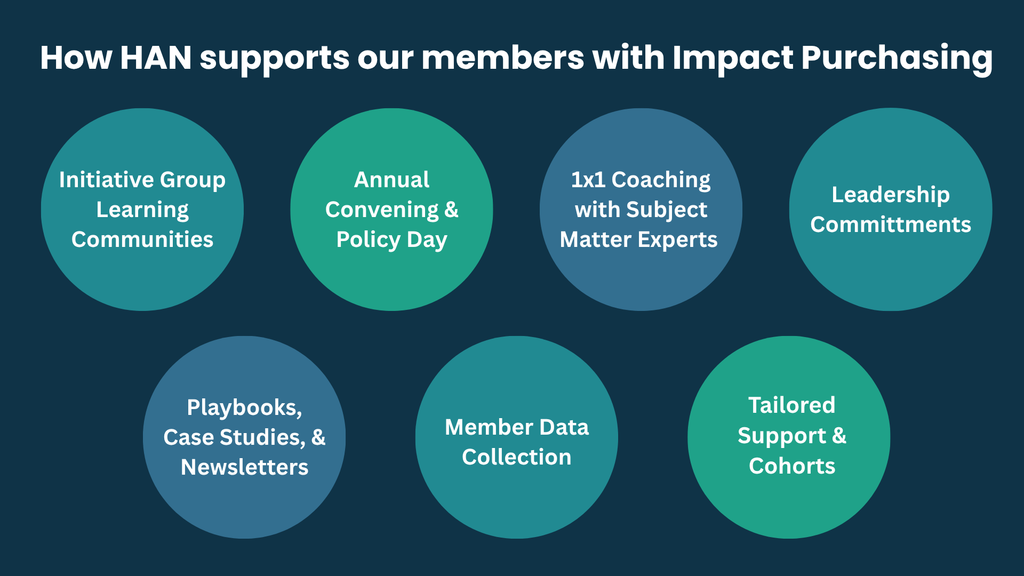
HAN’s Impact Purchasing Commitment 2030, developed in partnership with Health Care Without Harm and Practice Greenhealth, aims to harness the substantial buying power of health systems to build healthy, strong, and sustainable local economies through localized supply chain spending and environmental sustainability practices.
Recent Initiatives
Power of Local Procurement (Local Impact Spending Study for IPC 2030 Signatories)
IPC 2030 Signatories are committed to building deeper relationships with high-impact, local businesses. To build on this commitment, HAN, in partnership with Civic Economics, is conducting a study designed to deepen understanding and measurement of community impact by quantifying the economic benefits for local communities when health systems prioritize purchasing from local businesses. The results of this study will demonstrate the real impact of IPC 2030, showing how health system leaders improve the well-being and economic vitality of their communities.
Building Resiliency through Employee Ownership
Business Resiliency through Employee Ownership (BREO) was an ambitious three-year, joint initiative designed to achieve significant growth in employee-owned businesses by leveraging the supply chains of health systems participating in the Healthcare Anchor Network. Through the work of IPC 2030, signatories will work to equip their supply chain vendors with knowledge about the value of employee ownership, including reducing supply chain risk, building stronger, more sustainable businesses, and building greater community wealth.
Impact Purchasing Case Studies
-
Kaiser Permanente Impact Purchasing Case Study
As one of the largest nonprofit health systems, Kaiser Permanente’s operations have tremendous economic influence. In 2023, Kaiser Permanente purchased…
-

Rush University System for Health: Local Business Suppliers
Rush University System for Health’s comprehensive anchor mission Business Supplier initiatives are featured in our latest case study. As an…
-

Children’s Hospital of Philadelphia Healthier Together Initiative
In 2019, HAN member Children’s Hospital of Philadelphia (CHOP) launched the Healthier Together Initiative, a $25 million, five year commitment to address…
Impact Purchasing News Updates

Uniting health care & agriculture for community
HAN member RWJBarnabas Health just launched ‘Harvest’ – a first-of-its-kind farm to community center in Newark, NJ to combat food insecurity, promote nutrition education, and empower local businesses. The health system is partnering with Newark-based farm-to-city social enterprise Urban Agriculture Cooperative (UAC) to improve overall health outcomes. This innovative initiative brings together the power of health care, agriculture, education, and economic development […]

Community long-term health & stability
HAN member Rush University System for Health is addressing food insecurity and strengthening its bond with the community through food security and urban farming initiatives. It is estimated that more than half a million residents of the nearby West Side neighborhood have difficulty accessing nutritious food, which worsens other health issues. Increasing access to food is part […]
Local food ecosystem building
Healthcare Anchor Network (HAN) member Trinity Health is working at the intersection of food production, economic development, and community cohesion—functioning as an anchor institution that circulates resources within a community. The Food is Medicine strategy entails the ownership and operation of multiple hospital-based farms in 25 states where it has hospitals and health services. The […]
Impact Purchasing Videos

Ready to Learn More?
Discover how Healthcare Anchor Network members are using impact purchasing to strengthen local communities.
For more information, contact Sylvia Daniels Ray, Senior Manager, Impact Purchasing: sdanielsray @ anchornetwork.org